【For Grade 2】HOW TO PRACTICE and SCORE EIKEN SPEAKING

QRコード
Read by a smartphone
NOTE: The information on this page is based on Aplus assumption and does not guarantee accuracy.
※このページの情報はえいぷらの想定に基づくものであり、正確性を保証するものではありません。
Scoring Cheat Sheet
| Category | Max Score | Evaluation Points |
|---|---|---|
| Reading | 10 |
|
| illustration | 10 |
|
| Q & A | 10 |
|
| Attitude | 3 |
|
| Total Score | 33 | |
| Score to pass | 20+ |
| Speaking (33) | |||||
|---|---|---|---|---|---|
| Reading (5) | 1 | ||||
| Pronunciation Correct pronunciation of individual words. |
+1 | ||||
| Stress Use natural stress patterns within words and sentences. |
+1 | ||||
| Intonation Use rising and falling tones appropriately for questions and statements. |
+1 | ||||
| Pacing / Rhythm Read at a natural speed without sounding rushed or robotic. |
+1 | ||||
| Clarity / Smoothness Speak clearly with smooth transitions between words. |
+1 | ||||
| Q&A (25) | 1 | 2 | 3 | 4 | 5 |
| Pronunciation Clear and natural pronunciation. Speaking more helps show accuracy. |
Many mispronunciations | Frequent mistakes | Some mistakes, mostly clear | Mostly accurate | Clear and natural throughout |
| Understanding of the question Answers should reflect the question. Full sentence responses are ideal. |
Little or no relevance | Partially relevant | Generally answers the question | Good understanding shown | Fully relevant and clear |
| Grammar accuracy Use correct sentence structure and verb forms. |
Frequent basic errors | Some basic errors | Occasional errors | Mostly accurate | Consistently accurate |
| Logical structure Include opinion → reason for best results. |
No structure | Minimal structure | Some logical flow | Clear structure | Well-organized and cohesive |
| Vocabulary use Use varied and topic-specific vocabulary. |
Very limited vocabulary | Basic words only | Some variety | Good variety and accuracy | Rich, appropriate vocabulary |
| Attitude (3) | 1 | ||||
| Effort to listen Shows active listening, eye contact, and response timing. |
+1 | ||||
| Clear and confident Speaks with confidence and natural tone. |
+1 | ||||
| Willingness to speak Tries to speak fully even when unsure or nervous. |
+1 | ||||
Basic Speaking Information
The most effective resource to prepare for the Eiken Grade 2 Interview is the official virtual tool available here.
*Eiken Virtual Interview, https://www.eiken.or.jp/eiken/exam/virtual/grade_2/ , 2025, Eiken Foundation of Japan
| Eiken Grade 2 Interview Steps |
|---|
| 1) Enter the room |
| 2) Hand over the interview card |
| 3) Take a seat |
| 4) Confirm your name and test level, and greet the examiner * The examiner will ask your name, grade, and begin greeting |
| 5) Receive the question card * The examiner will pass the question card |
| 6) Read the passage silently (20 seconds) * The examiner will ask you to prepare |
| 7) Read the passage aloud * The examiner will tell you to read aloud |
| 8) Answer a question about the passage (No. 1) * The examiner will ask a question |
| 9) Think about the illustration question (20 seconds) * The examiner will tell you to start |
| 10) Describe the sequence of the illustration (No. 2) * The examiner will tell you to start |
| 11) Turn over the question card * The examiner will tell you to turn over the card |
| 12) Answer a personal opinion question (No. 3) * The examiner will ask a question |
| 13) Answer another personal opinion question (No. 4) * The examiner will ask a question |
| 14) Return the question card to the examiner |
| 15) Leave the room |
PRACTICE
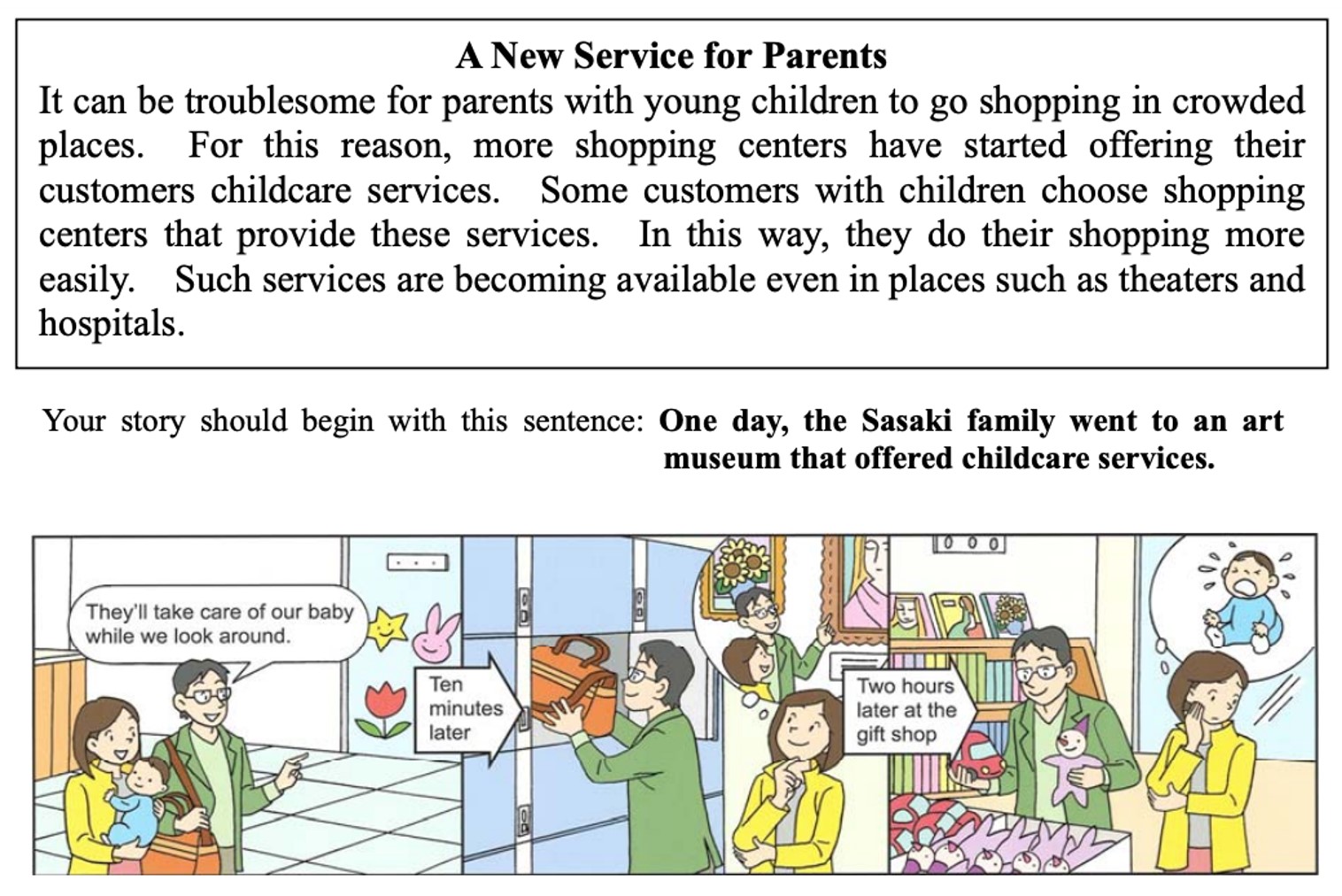
| Section | Interviewer | Student |
|---|---|---|
| Question about the passage | According to the passage, how do some customers with children do their shopping more easily? | Some customers with children choose shopping centers that provide childcare services. |
| Turn over the card and move to personal opinion question | ||
| Personal Opinion (Q3) | Do you think learning a musical instrument benefits children? | No, I think students should learn necessary skills such as programming. I think music will not help develop children's career. |
| Personal Opinion (Q4) | Do you think eating out is better than cooking at home? | I think eating out is convenient. But home cooking is healthier and cheaper. |